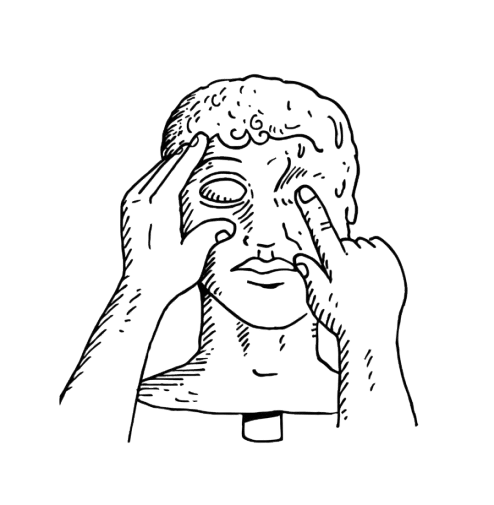
“Become what you are, having learned what that is.”
This line from the ancient writer Pindar struck a chord in the heart of a very young Friedrich Nietzsche. It’s both eerie and enigmati, an exhortation and a mandate. How do you become what you already are?
Most of us are more familiar with the term “finding yourself.” We often think of this as starting a new life in a new location — whether it’s India or Prince Edward Island — and hoping that some sort of epiphany will strike while we’re there. Maybe it will. Maybe it won’t. The timeline is uncertain, and the opportunity cost is great. Is this what Pindar meant when he wrote those words 2,500 years ago? “Finding yourself” and “becoming what you are” look, at first glance, like poetic ways of saying the same thing. They’re not.
In fact, they couldn’t be more different.
The self is created, not found
I confess I don’t like the phrase, “to find myself.” It’s vague and pseudo-mystical. It’s a strange combination of ambition and laziness in that we hope a sabbatical or a grand gesture will unlock the answers to our biggest questions.
Poet and novelist Robert Penn Warren has this to say on the matter:
As a last irony, let us turn to the words so frequently uttered by the yearning young — and, as a special phenomenon of our time, by the yearning not quite old, as well: “I am going to take time off and find myself.” “Time off” from school, from job, from [spouse] — from what? Free time: “to get away from it all” — whatever “all” is. But the key phrase is “to find myself.” 1

A quick interjection: I’ve always hated the phrase “to find myself.” I admit a bias here and agree with Warren that there’s something whimsical and vague about it.
He continues:
“In the phrase lurks the idea that the self is a pre-existing entity, a self like a Platonic idea existing in a mystic realm beyond time and change. No, rather an object like the nugget of gold in the placer pan, the Easter egg under the bush at an Easter-egg hunt, a four-leaf clover to promise miraculous luck. Here is the essence of passivity, to think to find, by luck, one’s quintessential luck. And the essence of absurdity too, for the self is never to be found, but must be created, not the happy accident of passivity, but the product of a thousand actions, large and small, conscious or unconscious, performed not “away from it all,” but in the face of “it all,” for better or worse, in work and leisure rather than in free time.”
In other words: No one-time journey or discovery, no matter how far-flung, gives you a blueprint for how to live happily ever after. Or some final static understanding of yourself.
By all means, take a vacation. Sit in stillness. Epiphanies do happen, and they are valuable, sometimes even profound. But there’s a difference between seeking an epiphany like a child hunting for Easter eggs and being ready to receive one because you’re already living and paying attention to every moment, no matter what your environment looks like or your day looks like.
We are less like the lofty fixed forms that Plato envisioned and more like the ever-changing river of Heraclitus. We do things, but things also happen to us. We can’t stop the water or slow it down, but we can choose how to react. We can choose what shape we’ll take. If any person understood the nature of becoming who you are, it was Friedrich Nietzsche.
We are the helmsmen of our existence
In the 1860s, Nietzsche’s star was rising. At just 24 years old, he was a professor of classical philology at the University of Basel. He wrote several well-received papers, and his colleagues respected him. He was on what looked like a well-secured path to success.
Nietzsche enjoyed his job, but wanted to broaden his horizons. His mind burned with the questions of existence. He longed to switch from teaching philology to teaching philosophy. Then he wrote his first book, The Birth of Tragedy, and things took a sharp turn.
The Birth of Tragedy was a flop. It sold only a few copies, and critics attacked it as out-of-touch and radical. One vicious review, in particular, devastated his reputation. Nietzsche’s university lectures went from 21 students in the summer of 1872 to only 2 students the following winter semester. If this were all he had to deal with, he might have hung on to university life. It wasn’t.
“We are responsible to ourselves for our own existence; consequently we want to be the true helmsman of this existence and refuse to allow our existence to resemble a mindless act of chance.”
From the time he was a child, Nietzsche suffered from migraines, digestive problems, and eyesight issues; as he grew older, they worsened. At times, the pain was so bad that he couldn’t work, read, or write. He vomited constantly. The last thing he did, however, was feel sorry for himself. In an early essay, he wrote: “We are responsible to ourselves for our own existence; consequently, we want to be the true helmsman of this existence and refuse to allow our existence to resemble a mindless act of chance.”2
Nietzsche’s health was the final straw; he quit his privileged job as a professor, never to return. For the rest of his life, he wandered and lived in different parts of Europe, seeking warmer weather to ease his pain. Sometimes he was with friends; often he was alone. Most of his relationships broke down, including his long-term friendship with the composer Wagner. The woman he loved rejected his offer of marriage twice. He almost ran out of money. His health grew worse.
In late 1888, Nietzsche finally caught a break. He experienced a short but brilliant burst of energy and wrote several works including his final, crowning book, Ecce Homo. In it, he comes to this realization:
“To become what one is, one must not have the faintest notion what one is. From this point of view even the blunders of one’s life have their own meaning and value – the occasional side roads and wrong roads, the delays, “modesties,” seriousness wasted on tasks that are remote from the task.” 3
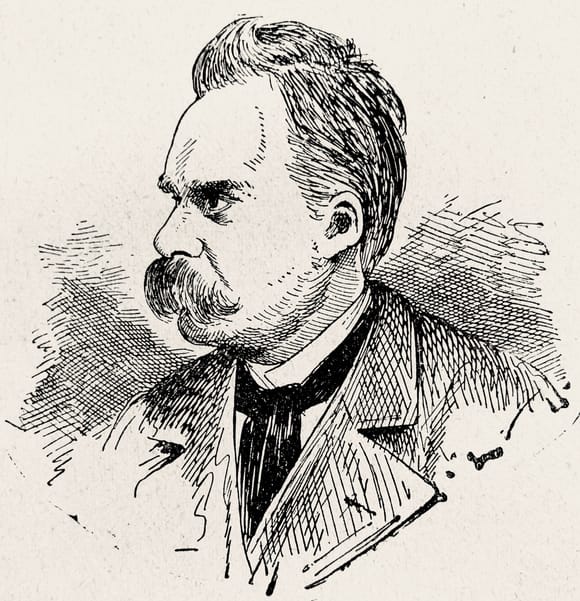
“Becoming who (or what) you are,” for Nietzsche, means embracing every aspect of your life, even the mistakes and sufferings. It means amor fati – to love your fate and not wish for it to be any different. At first, this might sound like a contradiction: how are we supposed to steer our lives if it means accepting whatever happens to us?
The answer, as the ancient Stoics knew, is recognizing the difference between what we can and can’t control. We may suffer depression, unfaithful spouses, or unexpected medical bills, but we chart a new course each time. We decide how these hardships will define — or not define us. The hurricane may have 30-foot waves, but we are the helmsman.
Less than one month after he finished Ecce Homo, Nietzsche collapsed in the streets of Turin. 4 He lived eleven more years as an invalid, insane, sedated by drugs, his memories gone — his intellect wiped. When he died in 1900, his sister Elizabeth had complete control of his creative property and appropriated it for the Nazi party. It would be years before his works and his ideas were restored to their true form.
Sometimes we continue to become who we are even after we die.
Our task: to be sculptors and productive human beings
John Kaag is a philosophy professor who spent years trying to find deeper meaning in his life. His solution was to follow Nietzsche’s literal footsteps in the Alps — his first try in his early 20s failed miserably. When he returned as a husband and father, there was still no ah-hah moment. No fireworks.
Then, during his last few days wandering around the Swiss landscape, Kaag had the same realization as Robert Penn Warren’s:
As it turns out, to ‘become who you are’ is not about finding a ‘who’ you have always been looking for. It is not about separating ‘you’ off from everything else. And it is not about existing as you truly ‘are’ for all time.’ The self does not not lie passively in wait for us to discover it. Selfhood is made in the active ongoing process, in the German verb werden, ‘to become.’ The enduring nature of being human is to turn into something else, which should not be confused with going somewhere else. 5
You can’t find what doesn’t exist yet. We are lumps of matter that we’re responsible for molding, but unlike a sculpture, the process is never finished. It’s a lot of work, and the work doesn’t end. Most uncomfortably of all, becoming who we are means making choices instead of letting the universe make them. We are responsible for how we turn out, well or shoddily.
“It is a myth,” Nietzsche proclaims:
…to believe that we will find our authentic self after we have left behind or forgotten one thing or another … To make ourselves, to shape a form from various elements – that is the task! The task of a sculptor! Of a productive human being! 6
Becoming who you are requires the strength to constantly make choices, sometimes big ones, without being swallowed by anxiety. It is deciding what you value and what you don’t. Above all, it is endlessly learning, stumbling, questioning, and adjusting. We can do this in an Alpine hut, a Balinese bungalow, or a dingy basement, but if we don’t do it at all, we aren’t much different from the rest of the animals.
Become what you are, having learned what that is.
***
Read Next: Braving the Wilderness: How to Live to Yourself →
Footnotes
- Warren, Robert Penn. Democracy and Poetry. Harvard University Press, 1975.
- Breazeale, Daniel, editor. Nietzsche: Untimely Meditations. Cambridge Texts in the History of Philosophy, Cambridge University Press, November 6, 1997.
Nietzsche, Friedrich. On the Genealogy of Morals and Ecce Homo. Edited by Walter Kaufmann, Vintage, December 17, 1989.- No one is quite sure how it how happened. One popular story is that Nietzsche threw his arms around a horse, but this is most likely apocryphal.
Kaag, John. Hiking with Nietzsche: On Becoming Who You Are. Farrar, Straus and Giroux, September 25, 2018.- NF-1880,7[213] — Unpublished Fragments End of 1880.”