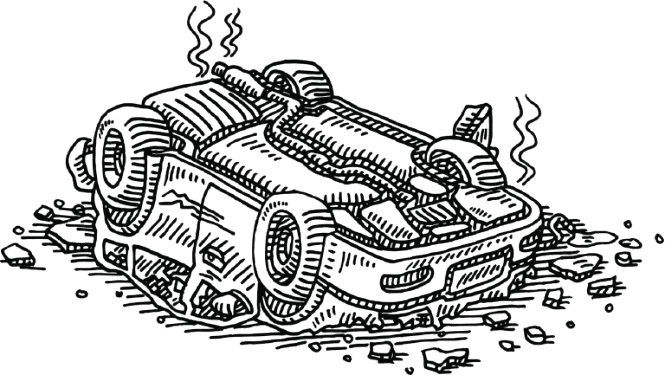
When I was twenty-three, I was in a car accident.
As I was driving through an intersection, I saw a truck coming toward me from the left. The light was red, but the driver didn’t care — they barreled on through. As fast as I could, I swerved to the right to avoid being T-boned.
The truck scraped the side of my car, careened into the traffic island, and flipped upside down (luckily, both the driver and passenger were wearing seatbelts). Hazard tape and cop cars covered the scene within minutes, and a film crew took position on top of a nearby building.
Was it luck or reflexes that helped me survive? It was probably some of both, but I’ve been coming to terms with the “luck” part ever since.
I walked away from the scene without a scratch. I even declined the police officer’s invitation to visit the hospital. It felt tempting, even natural, to rewrite the awful event in my mind: yes, I had come close to death, but of course I had been spared. I was the protagonist in my life, so I would never actually die or come to any serious harm — just like the main character in an action film or a novel.
But this was nonsense, and I knew it. I’d had a brush with mortality. Just a few seconds’ delay, and I would have wound up in the ER or a morgue. The crash site being filmed and photographed wasn’t of some random stranger; it was me. And I was the random stranger to all the gawkers and news watchers.
I learned that day that I was lucky, but not special.
“I Never Thought It Would Happen to Me”
Each of us is special, you could argue.
We have unique talents, experiences, and personalities. What’s more important, though, is the meaningful role we play in the lives of a select few. My mom’s face is just one of anonymous millions to a stranger, but not to me. The sight of her in a crowd changes everything. She’s a beacon of comfort and familiarity. And so is every other face in the crowd — to someone else.
From an impersonal cosmic view, however, we are all strangers. None of us gets a hall pass from danger, harm, or unpleasant events. The quality of our lives depends very much on how we come to terms with this.
American psychiatrist Irvin Yalom, in his book Love’s Executioner, shares the story of Elva: an older widow who comes into his office looking dejected. She tells Yalom, “I never thought it would happen to me.” The event in question is the theft of her purse.
In talking with Elva, Yalom learns:
Along with her purse and her three hundred dollars, an illusion was snatched away from Elva –the illusion of personal specialness. She had always lived in the privileged circle, outside the unpleasantness, the nasty inconveniences visited on ordinary people – those swarming masses of the tabloids and newscasts who are forever being robbed or maimed.
The robbery changed everything. Gone was the coziness, the softness in her life; gone was the safety. Her home had always beckoned her with its cushions, gardens, comforters, and deep carpets. Now she saw locks, doors, burglar alarms, and telephones. She had always walked her dog every morning at six. The morning stillness now seemed menacing. She and her dog stopped and listened for danger. 1

I relate to Elva. My driving incident permanently changed the way I view the road. I don’t let anxiety keep me from buying groceries, but I’m aware that I take a risk every time I do.
While I’m not a fan of living in denial, it’s also not exactly fun to live knowing that a Sword of Damocles hangs over my head — over all of our heads — our entire lives. That sword is made more bearable by the fact that it’s usually invisible, but it’s always there. And each of us has to find a way to coexist with it as we buy groceries, get married, have children, and fly across the world on jumbo jets.
“Cheerful Pessimism”
The ancient Stoics had a unique approach to dealing with the illusion of specialness: premeditatio malorum, “the premeditation of evils.”
The idea was to allow yourself to imagine all the terrible things that could happen to you and make peace with the outcome in your mind. Then, when the ancient Roman equivalent of a car accident happened, you weren’t shaken to your core. As Seneca puts it:
This is why we need to envisage every possibility and to strengthen the spirit to deal with the things which may conceivably come about. Rehearse them in your mind: exile, torture, war, shipwreck…All the terms of our human lot should be before our eyes; we should be anticipating not merely all that commonly happens but all that is conceivably capable of happening, if we do not want to be overwhelmed and struck numb by rare events as if they were unprecedented ones. 2
A more modern take that I like even better is “cheerful pessimism.” This term comes from the Nobel-winning psychologist, Daniel Kahneman. He shared the following thoughts in an interview less than a year before he passed away:
Interviewer: …[Y]ou claim that if you’re a pessimist, life never disappoints you. Is this true and has it served you well?
Kahneman: That is true. I am a pessimist. I have been called a cheerful pessimist because I’m usually in a fairly good mood. So when I lose my keys, my first impulse is that I will never find them again although I should know better but this is how I think. So I’m prepared, I’m already figuring out what will I do if I never find my keys. 3
As someone who’s lost keys and other objects more times than I’d like to admit, I find this idea immensely practical. If things look iffy, just jump to Plan B! Focus on what’s in your control. Maybe the keys won’t show up, but you can call a locksmith and get new ones made. Your purse was stolen? Cancel your credit cards. Be grateful it wasn’t a Birkin bag. Move on.
Elva’s problem is that she expects things to always be normal, never bad. She fails to meditate on the possibility of her purse being stolen, leaving her with feelings of outrage and helplessness instead of a game plan when it actually happens. The Stoics realized this was a recipe for emotional disaster, and so they wisely prescribed the “meditation of evils” as a preventive exercise.
But there’s a question looming over all this, for me and maybe for you too. It’s simple enough to be cheerfully pessimistic about losing our keys or even being robbed. With some effort, we can be cheerfully pessimistic about losing our legs to a tractor accident or 90% of our life savings to the worst market crash in the history of the world.
But what about having a child afflicted with terminal cancer? What about losing someone you love, either to death or to a condition that renders them fundamentally altered? Some losses don’t admit of silver linings. It would be morally indefensible to look for them.
The Stoic philosopher Epictetus is famous for a thought experiment in which the reader is encouraged to imagine their child or spouse dying, each time they kiss them goodnight. Do this and you will not be disturbed if they really do die, he advises. Tomorrow is not promised, after all.
Wise words — but there is something too neat, too cold in this advice. It can help prepare us to be less shocked should the worst case ever happen, but in the meantime, it does little to comfort us in a world of uncertainty.
Hope means not knowing and yet having a positive bent that lies somewhere between longing and trusting.
We may not be “personally special” in the words of Yalom, but is it wrong to wish we were? I believe the ingredient that keeps us from becoming true pessimists — as opposed to cheerful pessimists — is hope. Hope is a deeply misunderstood concept, too often confused with ignorance. Hope means not knowing and yet having a positive bent that lies somewhere between longing and trusting. If our hopes are too narrow or specific, they become foolish. But to hope that things won’t always be as bitter as they are now, that something different and better will come to light or come into being, is the most powerful mechanism I know for fighting darkness.
Philosophers, mystics, scientists, poets, and ordinary people have all found different solutions to the “illusion of specialness.” So far, no one has emerged as an uncontested winner. I choose to see that as a sign that each of us must do the hard but meaningful work of confronting the problem ourselves.
Perhaps we can think of it this way: for 99% of situations, cheerful pessimism works wonderfully. It even works for terrible things like theft and bankruptcy. When it comes to the worst of the worst, well, it can still help us better appreciate what we have now.
And considering that the (very) worst will not happen to most of us, that is not such a terrible bargain in the end.
***
Read Next: What Is the Relationship Between Luck and Happiness? →
Footnotes
- Yalom, I. D. (2012). Love’s executioner & other tales of psychotherapy (2nd ed.). Basic Books.
- Seneca. (2004). Letters from a stoic: Epistulae morales ad Lucilium (R. Campbell, Trans. & Intro.). Penguin.
- You can read the article here.