
We live in an age of rampant loneliness. This loneliness stems from a lack of two essential goods: meaningful relationships and solitude. It’s the paradox of our time.
Over a century ago, the poet Rilke wrote to his friend Kappus: “What is necessary, after all, is only this: solitude, vast inner solitude. To walk inside yourself and meet no one for hours — that is what you must be able to attain.” 1 His words are as true today as they were then, but the difference is that today it’s harder than ever to achieve true solitude; we have endless distractions at our fingertips and Internet connection everywhere except the most remote deserts and mountain tops.
Paul Tillich has one of the best definitions I’ve found:
Our language has wisely sensed those two sides of man’s being alone. It has created the word ‘loneliness’ to express the pain of being alone. And it has created the word ‘solitude’ to express the glory of being alone. 2
The historian David Vincent adds a footnote to this: “Loneliness is failed solitude.” 3
What is it about solitude that makes it so important and, at the same time, difficult to achieve? And if it’s opposed to loneliness, how is it compatible with human relationships – or is it? How can we find it “glorious” to be alone?
Solitude Is Not the Same Thing As Loneliness
One obvious difference is this: solitude is voluntary, loneliness is involuntary. The dreamy poet wandering the woods and the sad old woman in her living room are both physically alone, but the similarities end there. And if there’s anything we know from years of observation and research, it’s that enjoying time alone doesn’t come naturally. Not for everyone. Our capacity for solitude, or lack thereof, begins in childhood.
The psychologist Donald Winnicott, in a famed paper in 1958, observed that children who felt secure in the presence of their parents also felt secure in their absence – and that they began their exploration of solitude while they were still physically in the same room with them.4 This “capacity to be alone” doesn’t come pre-programmed in us, nor does it happen in a few days or even weeks. Being alone is boring, anxiety-inducing, or some queasy mixture of the two unless we find a way to activate our imaginations. Creating art, thinking about a problem in our heads, or paying attention to our surroundings and finding something interesting to look at are all examples of successful solitude.
And what about “failed solitude” – does this mean trying to do those same things, but without enough effort? Maybe. But I think failed solitude is something very different and far more passive: it’s being physically alone and relying on external distraction to avoid our deepest, most inner thoughts. Because thoughts, after all, are very difficult if we haven’t spent years cultivating them. They can overwhelm us, like creeping weeds or riptides, and there’s a smorgasbord of technological and entertainment companies that are happy to step in and help us bypass this problem.
Author Cal Newport has a definition of solitude that is strict but apt: A subjective state in which your mind is free from input from other minds.
According to Newport, you can experience solitude while being in the same room as other people – what matters is that your mind is your own. You are not listening to other people, but you also aren’t listening to podcasts or watching videos, or playing a game on a screen. Anything that does not require your mind to produce and concentrate on an original thought does not meet the requirement for solitude. 5
This sounds logical at first, but how do we define “input from other minds”? In particular, what about reading? Do the hours a bookworm spends in her library not count toward solitude?
To explore this idea further, I turn to Newport’s source of inspiration: Michael Erwin and Raymond Kethledge. In the introduction to their book Lead Yourself First, they write:
Solitude…can be found as readily while sitting alone in a restaurant as it can on Mount Rainier. It is not an objective concept but a subjective one. It is, simply, a subjective state of mind, in which the mind, isolated from input from others, works through a problem of its own. That isolation can be sustained, as it was for Thoreau or is for a long-distance runner. Or it can be intermittent, as it might be for a person who reads a book, which of course is a collection of someone else’s thoughts – and then pauses occasionally to think through a passage’s meaning. But what comes in between those moments of isolation must focus the mind, rather than distract it. 6
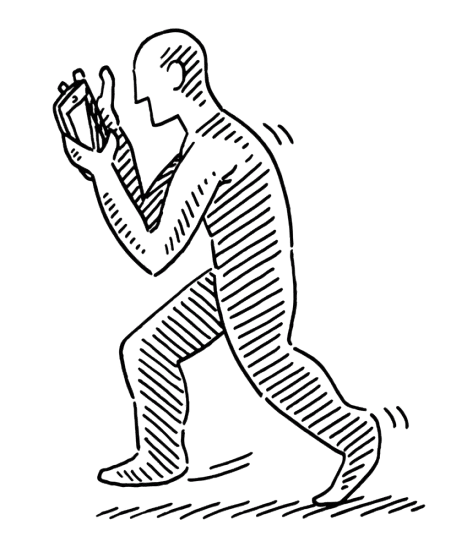
Working through problems in our minds has never been easier not to do in an era where even the poorest individuals can carry the Internet in their pockets almost everywhere they go. Solitude, Newport points out, used to be unavoidable: being stuck in line at the grocery store was a form of solitude because you had nothing to distract you except your own thoughts. Now that’s no longer the case: you can simply swipe an app and read/watch/listen to as much content as you please until the dreaded dead space has been filled by something other than your own inner thoughts.
K and E continue:
These inputs [e-mails, texts, online posts, etc.] distract the mind to no end, tying it down to the mere surface of thought, like a thousand Lilliputians. They do the same to the soul, keeping us from drilling down to where reserves of inspiration lie. Serious thinking, inspired thinking, can seldom arise from texts sent while eating lunch or driving a car. Responding to these inputs generates as much thought, and as much inspiration, as swatting so many flies. They deaden both the mind and soul.
The irony is that by avoiding solitude – intentionally or unintentionally – we are priming ourselves for loneliness. Because we haven’t cultivated our minds and sense of self, our relationships suffer, and time spent watching, reading, and listening to content that’s hand-fed to us on an algorithm only increases our creeping sense of dread and despair.
Psychologist Mihaly Csikszentmihalyi sums it up well when he says, “Solitude is a problem that must be confronted whether one lives in southern Manhattan or the northern reaches of Alaska. Unless a person learns to enjoy it, much of life will be spent desperately trying to avoid its ill effects.” 7
“A Room At the Back of the Shop”
If there was anyone who mastered the art of solitude, it was the philosopher-essayist Montaigne. After years of hectic public life in 16th-century France, one of the most tumultuous periods in cultural and religious history, Montaigne retired to his estate to reflect on what it was that he believed, thought, wondered, and felt. In one of his most memorable metaphors, he tells us that we must set up “a room, just for ourselves, at the back of the shop, keeping it entirely free and establishing there our true liberty, our principle solitude and asylum.”
This is not a physical room to retreat to whenever life becomes overwhelming, but a room we carry with us everywhere we go. Montaigne explains:
“That is why it is not enough to withdraw from the mob, not enough to go to another place; we have to withdraw from such attributes of the mob as are within us. It is our own self we have to isolate and take back into possession…[We must] “haul our own soul back into our self. That is true solitude. It can be enjoyed in towns and in king’s courts, but more conveniently apart.”8
He goes on to say that we must “haul our own soul back into our self. That is true solitude. It can be enjoyed in towns and in king’s courts, but more conveniently apart.” Then, in one of his most memorable metaphors, he tells us that we must set up “a room, just for ourselves, at the back of the shop, keeping it entirely free and establishing there our true liberty, our principle solitude and asylum.”
During Montaigne’s time and until recently, solitude was a life-affirming practice but was not dependent on physical or mental survival – at least, for most people. Now, a quarter into the 21st century, I question if that is still true. If anything, solitude is less of a luxury and more of a necessity for most of us, even as it’s becoming more endangered than ever. If we don’t learn to be alone with our thoughts to nurture them, there will be no self to haul back into our souls. Instead, we’ll be swept away by a current of noise and information and tumult and opinion with no filter to process any of it and understand who we are and what we really think and want.
***
Read Next: The Hedgehog’s Dilemma: 3 Ways to Not Be Lonely →
Footnotes
- From Letters to a Young Poet
- From his book, The Eternal Now.
- From his book, A History of Solitude
- Winnicott, D. W. (1965). The capacity to be alone. In The maturational processes and the facilitating environment: Studies in the theory of emotional development (pp. 29–36). Hogarth Press.
- From his book, Digital Minimalism.
- Kethledge, R. M., & Erwin, M. S. (2017). Lead yourself first: Inspiring leadership through solitude [Kindle edition]. Bloomsbury USA.
- Csikszentmihalyi, M. (2008). Flow: The Psychology of Optimal Experience (1st ed.). Harper Perennial Modern Classics.
- Montaigne, M. de. (1994). The Essays: A Selection (M. A. Screech, Ed. & Trans.). Penguin Classics.