Freedom and safety. These are two keys to a flourishing life, yet a tension exists between them. We see this at the public level all the time: Should people be allowed to do X? If so, when and how much? And how should we protect them from Y? What’s less obvious but just as important is the balance between freedom and safety in our inward lives. I suspect there the balance is even harder to manage.
Our world is increasingly noisy with competing voices who tell us what to think. How do we keep our mind open and free without being overwhelmed or exhausted? On the other hand, how do we seek refuge without becoming rigid or cloistered? We need a place we can go, to rest and meditate and to feel at home in a world that too often punishes those who are curious and sensitive with feelings of unrest.
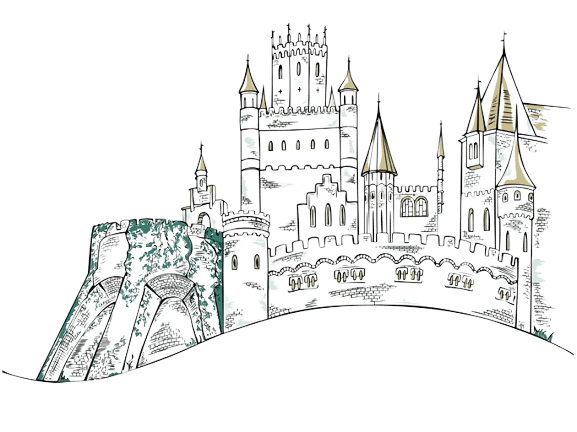
Different thinkers over time have addressed this problem, or parts of it. Some of them use the image of a fortress: a dwelling not meant for permanence, but for respite – I call it the Good Fortress. The Good Fortress is not a place where we hide from life, but where we go to recover so we can face it boldly and happily.
The “inner citadel” and “the back-shop room”
Marcus Aurelius writes in his Meditations:
The mind without passions is a fortress. No place is more secure. Once we take refuge there we are safe forever. Not to see this is ignorance. To see it and not seek safety means misery. 1
Aurelius isn’t suggesting that our minds (or hearts) be cold and stony, but that the “guiding principle” or deepest part of our soul has the power to judge what matters most – namely virtue, which is totally within our control – and this is where our true freedom lies. 2 If the only thing that matters is within our domain and can’t be taken from us, we are more impregnable than the sturdiest castle.
Pierre Hadot, a scholar of Stoicism, calls this part of our mind “the inner citadel.” He adds this insight:
When the guiding principle thus discovers that it is free in its judgments, that it can give whatever value it pleases to the events which happen to it, and that nothing can force it to commit moral evil, then it experiences a feeling of absolute security. From now on, it feels, nothing can invade it or disturb it. It is like a cliff against which the crashing surf breaks constantly, while it remains standing unmoveably as the waves come, bubbling, to die at its feet. 3
Marcus Aurelius’s formula, while simple, is incredibly dense. It takes a lifetime to practice and it touches on a vital truth: our efforts should be on only what we can control. But it doesn’t address how we should deal with feelings of anxiety or overwhelm on a personal basis; I find something is missing from the description of his “inner citadel.”
For that I turn to Michel de Montaigne, a man who was just as involved in the chaotic politics of his time as Marcus Aurelius was in his. In his essay “On Solitude,” Montaigne announces that one of the greatest things in life is to live to oneself. He urges us to set up “a back-shop room”: a part of our minds, he advises, must be a sanctuary dedicated to comforting and cheering ourselves. He writes:
“We have a soul that can be turned upon itself; it can keep itself company; it has the means to attack and the means to defend, the means to receive and the means to give…” 4
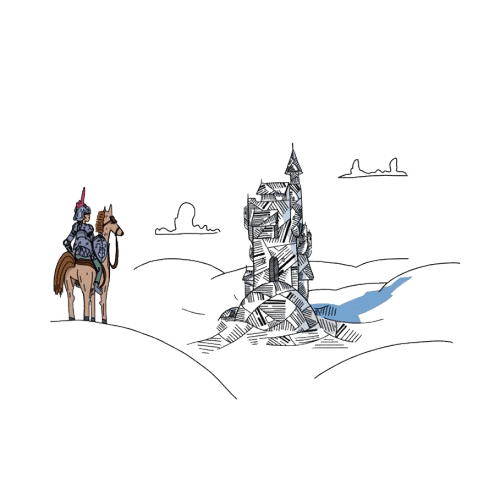
I find it interesting that Montaigne uses the analogy of a room and not a fortress, yet he uses the words “attack” and “defend,” both of which describe the qualities of a fortress – and I’m sure he would not object to the metaphor. There is something very comforting about the idea that we can be our own companions during moments of mental and emotional duress. Such duress may be a particularly trying event in either our personal lives or in current events, or it could simply be the existential anxiety that philosopher Martin Heidegger refers to as the feeling of “not-at-home” in the world. During times when everything is uncertain it’s natural to find some bit of warmth and comfort we can cling to; a roof over our heads from the existential storms of life.
I think this is not only healthy, it’s crucial to a sane and happier life. The problem is not in seeking refuge – it’s in refusing to leave it.
The Good Fortress should never be under siege
Real-life fortresses of bygone days were often unhappy places; especially during sieges, which were brutal for both sides and often lasted for months. But unlike physical fortresses, the Good Fortress need never be under siege. We may be attacked (or feel attacked) by noise and chaos but no one is camped out waiting for us. We choose when to enter the fortress and when to venture out again.
While the Good Fortress is a mental one and thus is a place we can technically have with us at all times, there is always a risk of drawing too far inward. The contemplative life does not mean retreating from everything worldly and uncomfortable, but to better navigate it. On the other hand, the “instinctive” person retreats permanently from the complexities of the world; they live in a world of their own making and the longer they stay there, the more vulnerable they are to being crushed by the actual world should they ever venture out.
Bertrand Russell offers this cautionary approach describing the differences between the two:
The life of the instinctive man is shut up within the circle of his private interests: family and friends may be included, but the outer world is not regarded except as it may help or hinder what comes within the circle of instinctive wishes. In such a life there is something feverish and confined, in comparison with which the philosophic life is calm and free. The private world of instinctive interests is a small one, set in the midst of a great and powerful world which must, sooner or later, lay our private world in ruins. Unless we can enlarge our interests as to include the whole outer world, we remain like a garrison in a beleaguered fortress, knowing that the enemy prevents escape and that ultimate surrender is inevitable. In such a life there is no peace, but a constant strife between the insistence of desire and the powerlessness of will. In one way or another, if our life is to be great and free, we must escape this prison and this strife.
…
Thus contemplation enlarges not only the objects of our thoughts, but also the objects of our actions and our affections: it makes us citizens of the universe, not only of one walled city at war with all the rest. In this citizenship of the universe consists man’s true freedom, and his liberation from the thraldom of narrow hopes and fears. 5
Now, your instinctive response might be, “But Russell and Montaigne (and Aurelius) are talking about different things!” and of course you would be right. Montaigne is describing the fortress or “room” of the soul as a place of relief and restoration, while Russell warns of those who take permanent refuge in those narrowest parts of our souls. That is the key difference. But even though it’s an easy enough difference to spot, I don’t think it’s an easy balance to strike. At all.
Consider, for example, how difficult it can be to practice epistemic humility about world affairs when it seems like almost everyone on the Internet (and in real life) is doing just the opposite. It might be tempting to have more fixed opinions of your own, or to instead retreat into the sanctuary of your own inner world and have absolutely nothing to do with any of it. The hardest thing is staying engaged and caring while keeping an open and positive mind, and being willing to change your mind as you reach new depths of insight.
This is why I find Montaigne’s metaphor of the room at the back of the shop so powerful: he is not suggesting that we avoid being out in the world, communally, politically or otherwise – he was the mayor of Bordeaux for four years, and worked among political elites. Rather, he is suggesting that we have a little pocket in our soul where we can return to commune with ourselves, to think, to rest, to be.
To have a mind that is both free and safe will be a balancing act for the rest of our lives, but Montaigne and Russell give us a glimpse to show us not just that it’s possible, but that it may be the happiest way to live.
***
Read Next: On the Need to Live and Love the Questions →
Footnotes
- From his Meditations. 8.48. Hays translation
- The term the Stoics used for this part of the soul specifically is hēgemonikon.
- Hadot, P. (2001). The inner citadel: The meditations of Marcus Aurelius (M. Chase, Trans.). Harvard University Press.
- From his essay “On Solitude.”
- From The Problems of Philsophy, by Bertrand Russell.