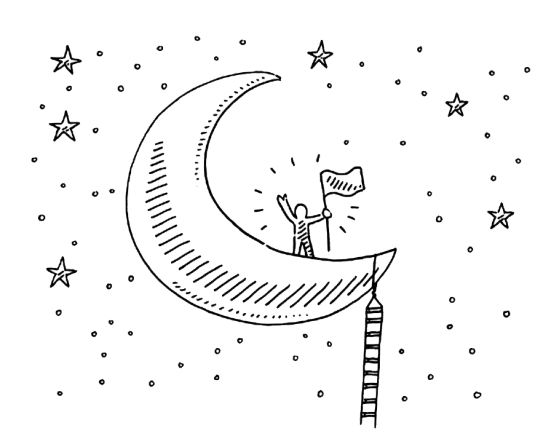
In a letter to his mother in 1855, a young William Morris wrote:
“I do not hope to be great at all in anything, but perhaps I might reasonably hope to be happy in my work, and sometimes when I am idle and doing nothing, pleasant visions go past me of the things that might be.” 1
There is some irony here. The main reason this letter exists for the public today is because Morris did become great — and at more than one thing.
In addition to being one of history’s most famous textile designers, Morris went on to become a poet, an artist, and a writer. But that’s not what strikes me as most interesting about his remark. Rather, it’s his tantalizing suggestion that it’s okay to live a modest life and dream about things that will never happen.

In our modern, hyper-ambitious world, we are bombarded with advice, “help,” and even criticism on how and why we should make our dreams come true. We have more choices and opportunities than ever before, so there is no excuse for staying in “dream mode.” Or for wasting our time imagining or exploring things we’re not talented at or serious about pursuing.
I have a different opinion. Daydreams, rather than a threat to our growth and success, are a necessary part of it. To have any hope of becoming a William Morris, we must dream a lot. Most of those dreams will come to nothing; they are the happy casualties that pave the way for the few dreams that do come true.
But even more radically, I believe that daydreaming is important for its own sake because it’s one of the most human things we can do.
We never outgrow our need for play
Daydreaming has never had a great reputation to begin with.
“A happy person never makes fantasies,” wrote Freud, “only an unsatisfied one.” 2We often associate fantasy with silliness, procrastination, laziness, and even shame. A series of studies from 2002 found that individuals who indulged in positive fantasies about a desired result – whether it was work, school, or a romantic crush – were less likely to achieve what they wanted than individuals who took their desires seriously.3 “Don’t just dream about it, make it happen!” is the conventional advice.
An excess of daydreaming can be destructive, but by definition, so is an excess of almost anything. The psychologist Jerome Singer has done more to defend and help us rethink the concept of daydreaming than any other individual I know of.
In his classic book The Inner World of Daydreaming he tells us:
Recognizing that our daydreams are in a sense an extension of our childhood capacities for enjoyable play, we can continue with this spirit of play and use it for many purposes in our daily life. We have of course to build it into a self-checking system that keeps us from driving off the road or bumping into objects…But if we can fit a certain amount of playful daydreaming into our sequence of activities it will serve as pleasant pastime and additional resource. 4
We never outgrow our need for play. If we did, things like DnD and fantasy football wouldn’t be the billion-dollar industries that they are. Some of our daydreams may have the potential to “come true,” but if we want lives of rich creativity, I believe, we must be content to daydream without a concern for “return on investment.” There is enjoyment in imagining for its own sake.
Daydreaming also rescues us from monotony and discomfort, whether it’s a long airport layover or staying up all night with sick children. I fear that the good-intentioned desire to be present and mindful is sometimes at odds with the need to daydream, and we give all our praise to the former. I love staring into my daughter’s eyes and being “in the moment,” but I feel no shame in imagining us one day taking a trip together to Ireland or Rome.
Daydreaming is a bittersweet vehicle for us to experience as much of life as we can in our limited bodies.
There is another benefit to daydreaming that’s maybe even less appreciated: experimentation.
In The Inner World of Daydreaming, Singer mentions that he had three alter egos as a child: an athlete, a senator, and a composer. In each of these fantasies, there was “a small reality.” His fantasy of being a sports star led him to play sandlot baseball and football “with a moderate amount of success.” His fantasy of being a senator led him to later dabble in political events. And his fantasy of being a composer led him to learn music and write compositions, even though his efforts were so inferior to his fantasies that he soon gave it up.

The gap between fantasy and reality makes creative effort difficult, but this kind of “daydreaming experimentation” is a refining process that helps us discover what we love versus what we only like or feel curiosity for. When I was eighteen, I took an acting class because acting sounded very romantic, and it seemed like everyone I knew (but me) had been in a play. The class was both much harder and more rewarding than I thought it would be. Most importantly, when it was over, I realized the class had more than satisfied my interest, and I went on daydreaming about other things.
Daydreaming is not just about idling away your time — sometimes it’s about dabbling. And dabbling helps us discover who we are.
“Intimate immensity”
Daydreaming, above all, evokes our deepest emotions and connects us to things bigger than ourselves. Our imaginations are what give us the ability to be in awe of beautiful things and to stretch our minds to their limits.
The French philosopher Gaston Bachelard calls this “intimate immensity”:
One might say that immensity is a philosophical category of daydream. Daydream undoubtedly feeds on all kinds of sights, but through a sort of natural inclination, it contemplates grandeur. And this contemplation produces an attitude that is so special, an inner state that is so unlike any other, that the daydream transports the dreamer outside the immediate world to a world that bears the mark of infinity. 5

Daydreaming is a bittersweet vehicle to experience as much of life as we can in our limited bodies. No matter how many wonderful and impressive things you achieve in this life, there will always be a million more that you’ll never have time to do.
It’s natural to feel frustrated or even depressed by this. We don’t want to give our precious attention to castles in the air, and usually for good reason.
Daydreaming, far from being a frivolous waste of time, is a bittersweet vehicle for us to experience as much of life as we can in our limited bodies. No matter how many wonderful and impressive things you achieve in this life, there will always be a million more that you’ll never have time to do. Most of us see this as negative. We don’t want to give our precious attention to castles in the air, and usually for good reason.
But what if we embraced the fact that we’re capable of this inner world-building? The melancholy of daydreams never coming true is the price we pay for our imaginations: powerful, mysterious labyrinths of synapses that are capable of wondering what isn’t. A squirrel only thinks of nuts and shelter and procreation (so far as we know). It’s the same for all the other animals. We have the unique fortune of being able to create worlds in our minds without end.
In a world obsessed with utility and optimization – where hobbies are forced to become side hustles and leisure must justify itself – the act of imagining for its own sake is deeply human. Imagination, free of expectation, allows us to enjoy small, private moments that needn’t lead anywhere, become anything, or be known to anyone else.
Would William Morris have become the father of the Arts and Crafts movement had he not allowed himself idle moments of daydreaming? Something tells me no, although we’ll never know either way. Too much daydreaming leads to a life disconnected from reality, but a life without daydreaming is stunted and sterile. A select few of our dreams will be the ones we labor and fight for; the rest will be “pleasant visions” for our mind’s eye to find rest and enjoyment in.
***
Read Next: Boredom is the Gateway to Good Things →
Footnotes
- Kelvin, Norman, ed. The Collected Letters of William Morris, Vol. 1. University of Pennsylvania Press, 1982.
- Freud, S. (n.d.). Collected papers, vol. 4. Basic Books Inc.
- Oettingen, G., & Mayer, D. (2002). The motivating function of thinking about the future: Expectations versus fantasies. Journal of Personality and Social Psychology, 83(5), 1198-1212. You can read it here.
- Singer, J. L. (1975). The Inner World of Daydreaming. Harper & Row.
- Bachelard, G. (1992). The poetics of space (New edition). Beacon Press.