
On his 38th birthday, in the year 1570, Michel de Montaigne quit his job as a judge at the Court of Bordeaux and retired to a private tower. Here he went on to write the thoughts of his heart in peace and quiet for the next twenty years, mostly without interruption. Above one of his bookshelves he wrote an inscription in Latin that ended with these words:
If the fates permit, he will complete this abode, this sweet ancestral retreat; and he has consecrated it to his freedom, tranquility, and leisure.
Montaigne wrote about everything and anything that interested him: philosophy, death, sex, marriage, cannibalism, moral psychology, friendship, parenthood —even coaches. He disregarded the norms of the time that required writing to be formal and structured, and openly talked about himself, including his favorite foods and his battle with kidney stones. In one of his most memorable essays he writes about the need for a “back-shop room” in our souls: a figurative place where we can retreat, reflect and enjoy our own company whenever life becomes too frantic or difficult. 1
But of all the topics Montaigne discusses, including the need for a metaphorical room of our own, nowhere does he mention the need for a physical room. He mentions his tower, his “abode, consecrated to his freedom” only incidentally throughout his essays. Nowhere does he tell his reader, “You must set up an actual room or a tower of your own.”

It’s not hard to find an explanation for this. Shelter is a basic human need; we shouldn’t take a home of our own for granted but most of us have this need covered. It’s also possible that Montaigne didn’t wish his readers to compare themselves to him, to mistake the trappings of an ornate sanctuary, with rows of hundreds of books, to the thing that matters most: the figurative fortress within our own minds. All of this I can agree with, but I don’t think it’s as simple as that.
A home is more than just a place to sleep and eat cereal in our underwear. It’s our inner sanctum. It’s the shell that protects our body and mind. It’s where many of us will spend the majority of our lives. One of the most interesting things to me is the experience of visiting other people’s homes; I’m sure you know what it’s like to be in a home that glows with life as well as one that feels more like a prison or a dumping ground. Homes are such an intimate space that in Japan, for example, it’s not uncommon for new owners to tear down the house they acquired to build a new one, rather than live with old ghosts.
Our homes reflect much about us, but I think the reverse is just as true: when we are intentional about how we live, it affects our environment — whether we live in a mansion or a studio apartment. There is plenty of advice and opinion on how to design your home, but I am more interested in appreciating the sheer importance of a sanctuary, a sacred “charging station” for our personal batteries, whether that be our entire residence or a single room or a nook. I think the power of a reliable, beautiful physical sanctuary is one that many of us underestimate.
A home, writes philosopher Gaston Bachelard, “maintains [us] through the storms of heaven and through those of life. It is body and soul. It is the human being’s first world.” 2 He describes a house (home) as a “large cradle” that encloses us and comforts us from the moment we’re born. As we grow older we are inevitably “cast into the world,” but our need for a familiar space and a sanctuary to think and dream never goes away. In fact, the older we get and the more buffeted by life we become, the more I’m convinced we need it.
Even if we are homeless and destined to wander, some sort of reliable sanctuary is necessary to keep our spirits up. Friedrich Nietzsche found his sanctuary in a small room at a private house in Sils-Maria, Switzerland, where he was welcomed by the landlords and the residents. Walter Benjamin, a German philosopher in exile in 1930s Europe, found sanctuary at the national library in Paris. Soviet refugee and poet Joseph Brodsky found refuge in hotel rooms. And so on. The human need for spiritual and intellectual refuge is so great that we will accept it in any form we can.
But ideally, we have a home of our own to call our sanctuary, however humble. We may not own it (I don’t own mine), but we must have four walls and a key to lock the world out. Even this is not always easy – “intellectual freedom depends upon material things” Virginia Woolf rightfully pointed out 3 — but it’s a vital good. The point is not to have luxury to surround yourself with (although that’s nice if you can get it), but to have privacy. Montaigne retreated to his tower not only to be with his 1,500 books, but to be away from his family and servants. When he said that solitude can be enjoyed “in town and in king’s courts, but more conveniently apart”, I have no doubt that he was referring to his precious tower.
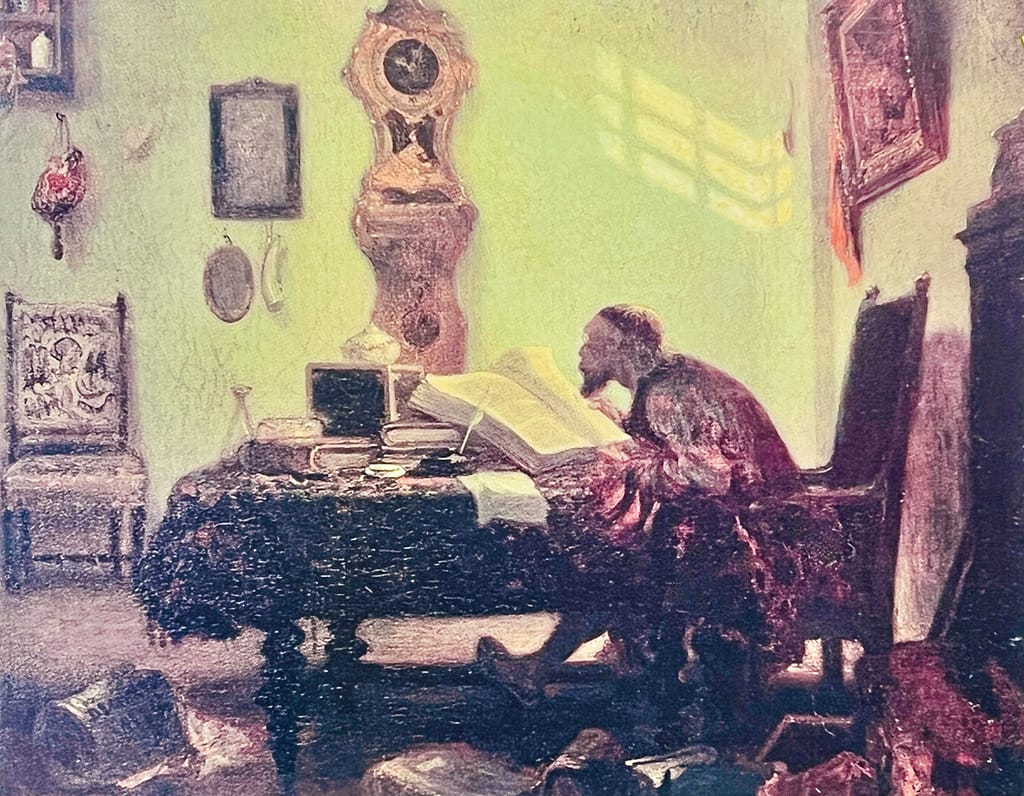
Likewise, depending on the time of day and who else is (or isn’t) at home, I find sanctuary in my bedroom at my desk, in the bright-lit four walls of my daughter’s nursery, or in my living room that doubles as a home library. No cafe or bookstore, no matter how cozy, has the same effect. There are too many strangers and there is too much unpredictability. I feel exposed. With your own home, there is a sense of intimacy because you are responsible for every nook and cranny and what to put where and how it looks and how it feels — the safe familiarity this creates allows you to rest, but also allows you to work and think about ideas and problems that would be overwhelming anywhere else.
I love this description by the writer May Sarton:
I have a fire burning in my study, yellow roses and mimosa on my desk. There is an atmosphere of festival, of release, in the house. We are one, the house and I, and I am happy to be alone — time to think, time to be. This kind of open-ended time is the only luxury that really counts and I feel stupendously rich to have it. 4
I don’t relate to the fire and the mimosa, but I do keep flowers on my dining room table and many other touches that allow me to feel a sense of “festival” and release. Such rich privacy gives us back our dignity after a day of work, or whatever it is we do out in the world (including the virtual world) where we are made to feel small and insignificant.
In her highly original (and not always easy to understand) book The Human Condition, Hannah Arendt argues that our concept of privacy is not a timeless one. During the golden age of Athens, it was in public life where Greek citizens found freedom, meaning, and excellence — the home, on the other hand, was a place of deprivation and drudgery. Only much later did the notion of private property as a human good arise, as a place where we can take shelter from the hustle and bustle of the world and the judgments of others:
A life spent entirely in public, in the presence of others, becomes, as we would say, shallow. While it retains its visibility, it loses the quality of rising into sight from some darker ground which must remain hidden if it is not to lose its depth in a very real, non-subjective sense. The only efficient way to guarantee the darkness of what needs to be hidden against the light of publicity is private property, a privately owned place to hide in. 5
“Hide” is exactly how it feels sometimes to me, except that I am free (as we all are) to venture back out whenever we want. Our home is a fortress in the sense that it protects us and allows us to replenish, until we are ready to return into the world. Montaigne experienced this, too: although he was devoted to his tower, he was called away at one point to be the mayor of Bordeaux and also on occasion to court, to political meetings, and to travel with friends. I’m sure the time away made his sanctuary all the more comforting whenever he returned.
How does understanding that we need a physical sanctuary make any meaningful difference to our lives? Most of us have homes and aren’t shy about resting in them; we may even be proud homebodies. But there is a difference between rest and leisure; and there is a difference between escape and refuge, just as there is a difference between unplugging and recharging. One is passive, unconscious, instinctive. The other is intentional and effortful.
A physical sanctuary is comforting not because it hides reality from us or indulges us in things that are frivolous, but because it’s a safe haven where we can work on what matters most, in peace. If we are going to process what happens to us “in the real world” so that we are better prepared to go back out into the fray, our homes must be sanctuaries that make it as enjoyable as possible to be alone with our thoughts. Especially thoughts that aren’t easy.
Our home is a world, a mini cosmos, and we are the ruler. Like any ruler, it means that we are responsible for the outcome — in this case, of our mental and intellectual well-being. It’s a responsibility we can ignore, or one that we can choose to nurture and use wisely.
***
Read Next: The Good Fortress: On Finding Inward Freedom →